
OJHW Logo without description by Miyuki Morikawa and Toma-Jin Morikawa-Fouquet
Oxford Japanese History Workshop
‘Clark’s Board, Arishima’s Chess’
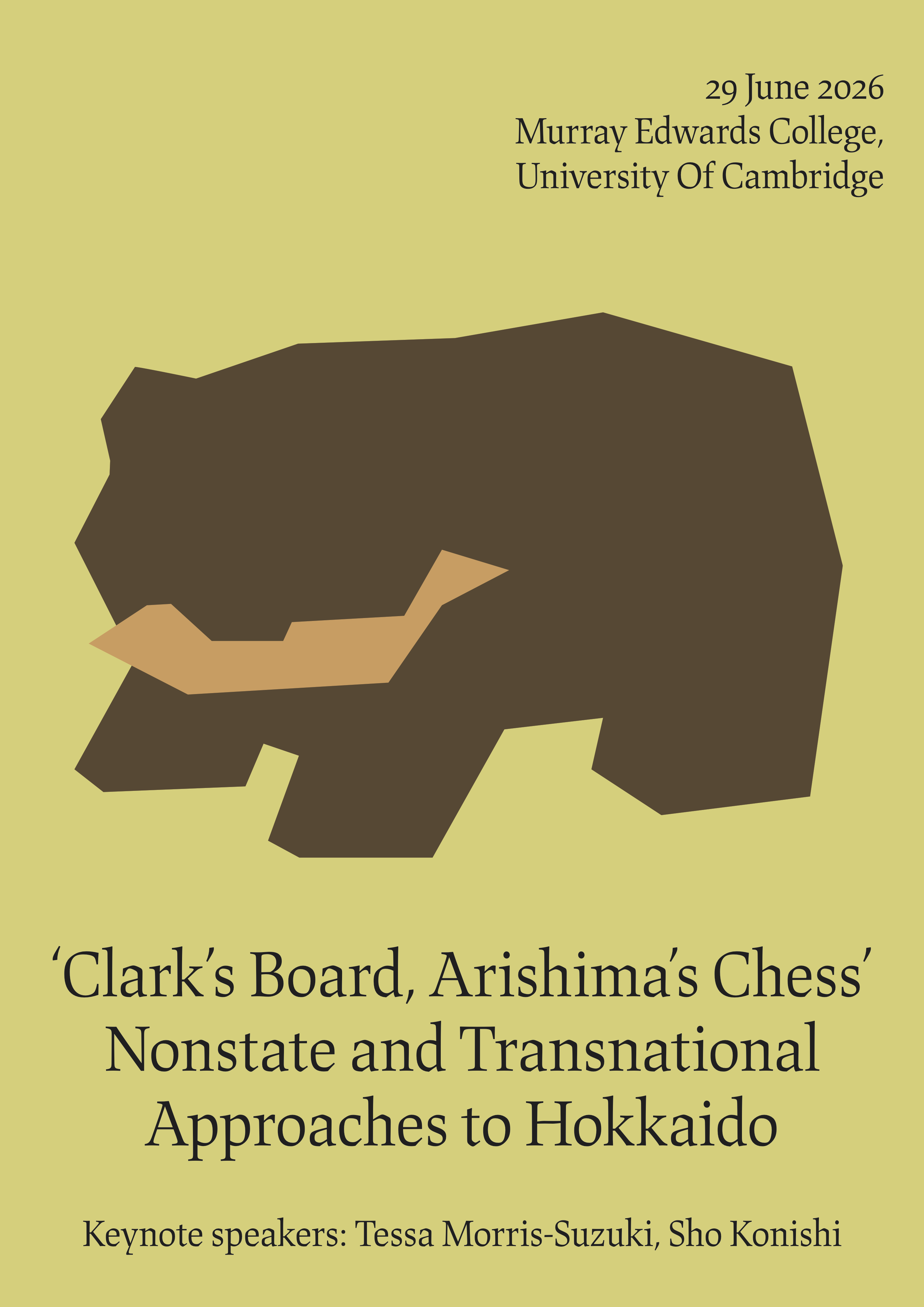
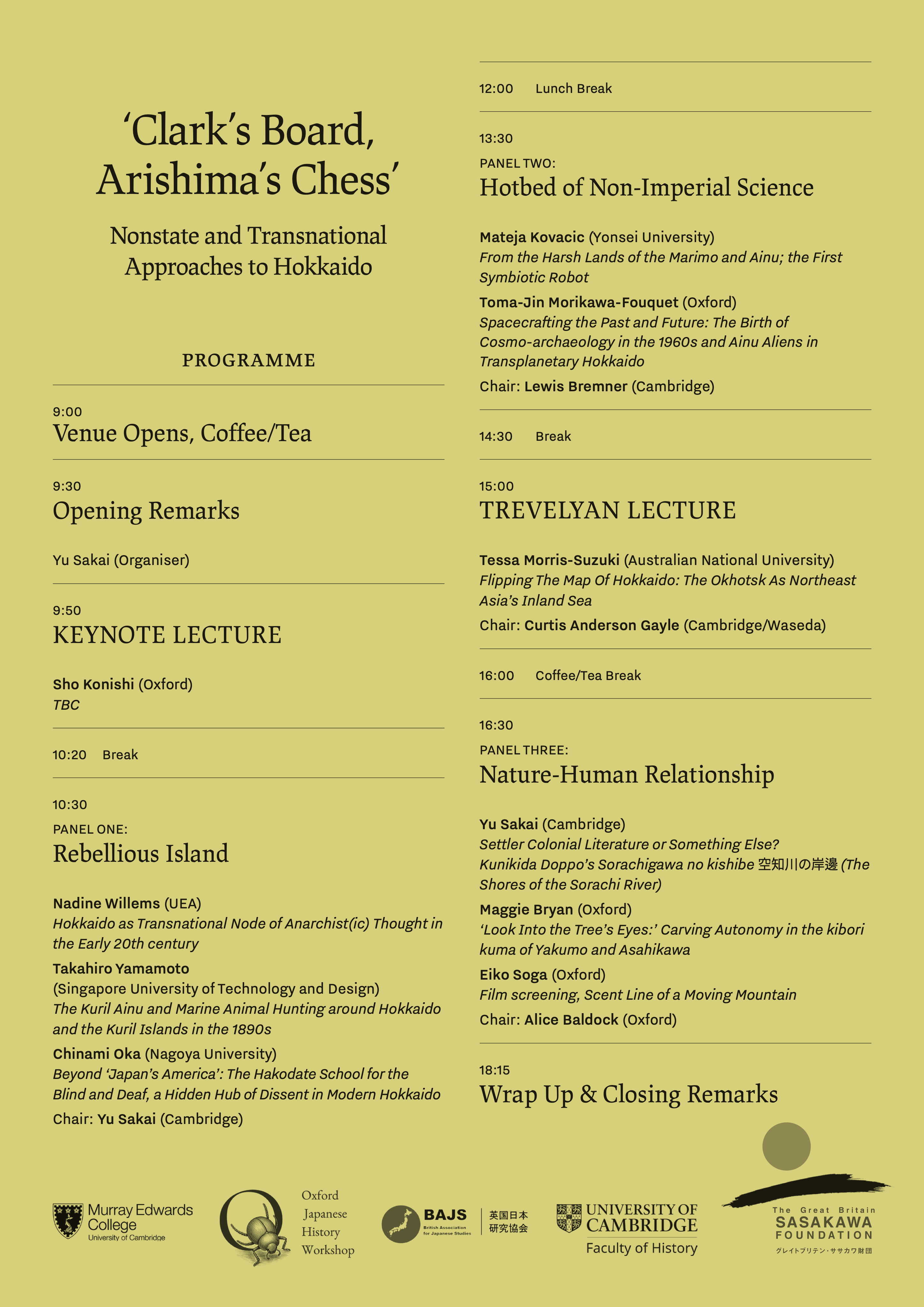
Nonstate and Transnational Approaches to the Study of Hokkaido
29 June 2026 09:00 – 18:30
Buckingham House Seminar Room, Murray Edwards College
Organised by Dr Yu SakaiThis conference aims to foster new historical understandings of Hokkaido through the lens of transnational and non-state perspectives. In examining vibrant activities and imaginations that unfolded within and beyond the islands, it will challenge the prevailing view of the islands as objects of colonisation and exploitation, recasting them as subjects of history in their own light.Borrowed from Sho Konishi’s Anarchist Modernity, the title of the conference ‘Clark’s Board, Arishima’s Chess’ embodies its aim and methodology of overturning conventional wisdom. The existing scholarship on Hokkaido focuses predominantly on state policy and emphasises the formidability of the exploitative systems and in particular the tragedies of Ainu people, leaving little room for agency. Konishi has shown that this was not always the case even at Sapporo Agricultural College, imperial Japan’s flag ship school of Western progress and enlightenment (established by the American educator William Smith Clark, hence ‘Clark’s Board’). Arishima chose this most unlikely of all the possible sites of state-sponsored knowledge production to educate his students in anarchist ethics that were antithetical to colonial knowledge (‘Arishima’s Chess’).Wildly popular manga Golden Kamuy (GK) will serve as important inspiration for this conference. In stark contrast to the state-centred narratives, it characterises Hokkaido at the turn of the 20th century as effectively outside the state control. Although the recently booming settler-colonial approach to Hokkaido has reinforced the dichotomy between the colonised (Ainu) and the coloniser (new settlers), the latter in fact consisted of such people as civil war losers, dissident Christians, and criminals who were unlikely to conform to state orders. Fugitives from the notorious Abashiri Prison and the rebel soldiers of the Imperial Army play a central part in GK. If anything, the story conveys the islands’ potential for self-realisation and resistance, represented by Hijikata Toshizō’s dream of an independent republic of Hokkaido.GK’s protagonist Asirpa, who has a Hokkaido Ainu mother and a radical Polish Sakhalin-Ainu father (modelled on Bronisław Piłsudski), embodies Hokkaido’s dynamic transnational non-state interactions with the outside world without and prior to state intervention. As Tessa Morris-Suzuki has consistently shown, Hokkaido was part of a vibrant, well-connected Okhotsk Sea region, spanning northern China, Siberia, Sakhalin, and Kamchatka. This perspective also contrasts with the recent scholarly trend to incorporate the northern islands into global history primarily through Western-centred and imperial or colonial connections and identify Hokkaido as a cradle for Japan’s future expansionism modelled on Western imperialism.In a similar vein to Konishi, Morris-Suzuki, and GK, shifting the lens from state to non-state, national to transnational, and formal structures to events on the ground and individual actors, the participants collectively overturn many of the most entrenched ideas about Hokkaido in the nineteenth and twentieth centuries, demonstrating:- Many meanings of Hokkaido, particularly as a non-imperial space and a site of resistance and alternative possibilities
- Intellectual, cultural, environmental, and economic interactions across borders involving non- state actors
- Demystifying Ainu as immobile, eternal, timeless ‘natives’
- the breaking down of coloniser-colonised, Wajin-Ainu binaries