

OJHW Logo without description by Miyuki Morikawa and Toma-Jin Morikawa-Fouquet
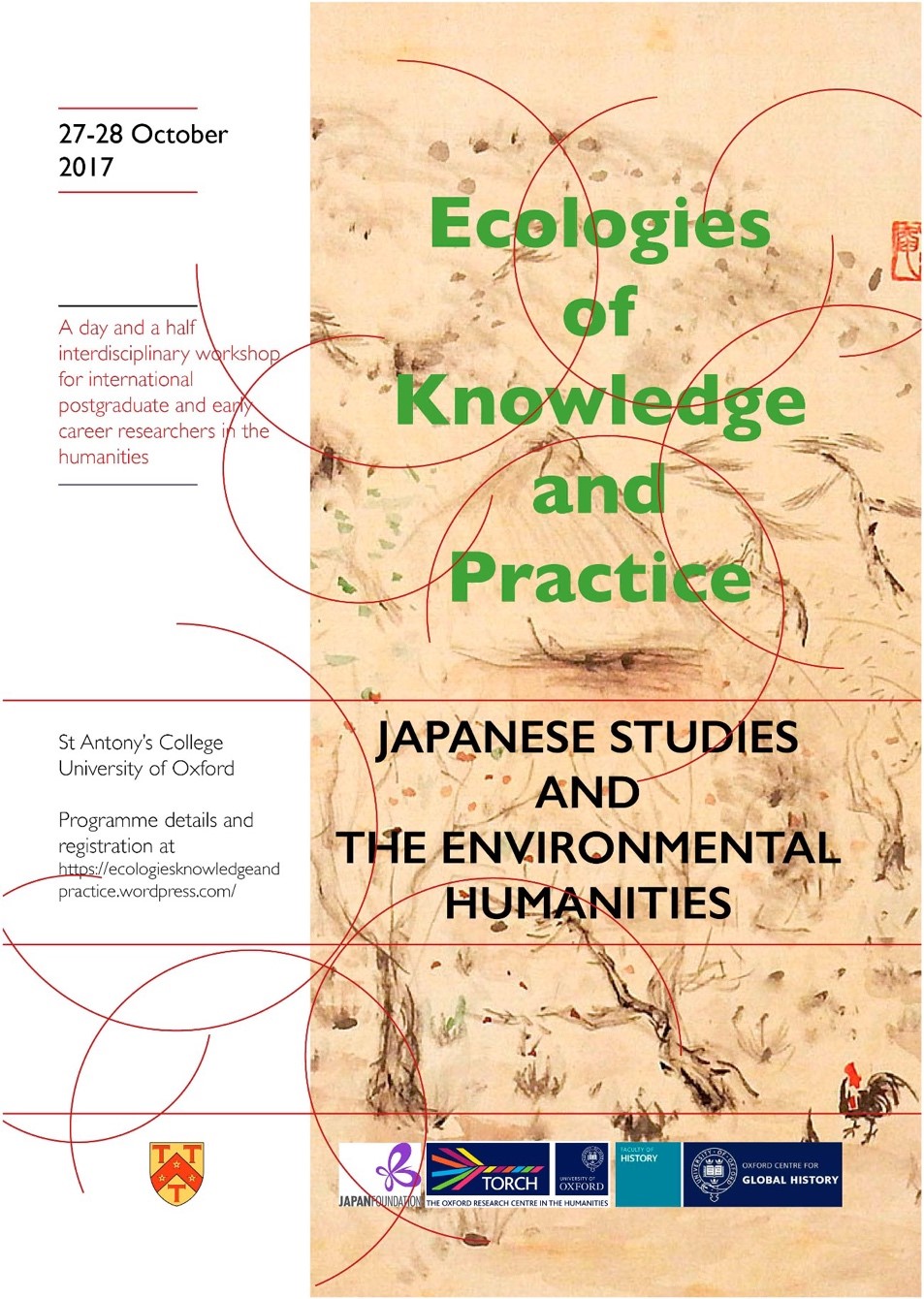
Ecologies of Knowledge and Practice: Japanese Studies and the Environmental Humanities
Postgraduate and Early Career Workshop
27 – 28 October 2017, 08:45 (27th) – 13:10 (28th)
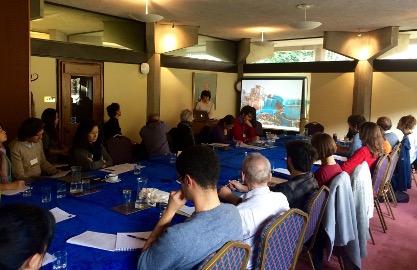
Fellows’ Dining Room, St Antony's College, University of Oxford
How does research on Japan inform ecological practice that is pertinent beyond the framework of area studies, and vice versa? If we were to place nature at the core of our studies of human activities, what new kinds of interdisciplinarity and knowledge would be possible, and how would we reorganize our academic disciplines? This workshop invites individual papers from Postgraduates and Early Career Researchers within the Humanities for an inter-disciplinary discussion with guidance from established scholars and practitioners.
In today's world of planetary-scale environmental crises, intellectuals are increasingly urged to cultivate a symbiosis between knowledge and practice and to engage with each other beyond disciplinary divides. Historically, Japan has claimed a uniquely harmonious relationship with nature. Yet this cultural rhetoric of ecology has faced challenges for its apparent discordance with the reality of environmental destruction in Japan.
The field of Japanese Studies outside Japan has also been criticised: on the one hand, for exoticising Japan as a unique "other", yet conversely, for forcing Japan into a hegemonic model of universal (Western) modernity. While such ideological controversies are ongoing, the study of Japan in the twenty-first century is becoming increasingly and inescapably intertwined with the rise of global environmental problems such as climate change, nuclear catastrophe, deforestation and threats to marine life. The challenges of ecocriticism follow hot on the heels of the politics of still-prevailing Orientalism.
In the rapidly changing academic and atmospheric climates of the twenty-first century, the career paths of current graduates and early career researchers are likely to follow very different trajectories to those of our seniors. The workshop seeks to open a dialogue among this emerging generation of international Japan scholars concerning how the production of knowledge of Japan may be linked to new forms of engagement with contemporary ecological concerns.
E-Brochure is downloadable from here.
Day 1 Friday 27th October
[ROOM: Fellows’ Dining Room, St Antony’s College, University of Oxford]
8:45 Registration
9:15 Acknowledgements
9:20 Self-Introduction by the participants and discussants
9:30 Introductory talk by workshop organiser I
“Ecologies of Knowledge and Practice without Supremacy: Perspectives from Japanese Studies”
Eiko Honda, St Antony’s College / Faculty of History, University of Oxford.
9:50 Panel I: Material Cultures of Nature [20min each, 30min discussion]
“Scientific Gaze, Consumer Gaze: Natural History and Commodification of Nature from Snow to Mount Fuji”
Mateja Kovacic, the Urban Institute, University of Sheffield.
“Crafting Ecologies: Exploring Japanese Bamboo Weaving as a Conduit between Knowledge and Practice”
Jo McCallum, Digital Craft, University of the Arts London.
“Putting together Bricolage and Thusness: An imaginary dialogue between Lévi-Strauss and Yanagi Soetsu”
Camille Sineau, Department of Social Anthropology, University of Aberdeen.
11:20 Break – Tea & Coffee
11:40 Panel II: Communities and (Post)Colonialism [20min each, 30min discussion]
“Can Cittaslow help? Resilience of Shrinking Rural Communities in Japan”
Heuishilja Chang, Oriel College / Department of Geography and the Environment, University of Oxford.
“The ‘Development’ of Hokkaido and Social Perceptions of the Natural Environment”
Pia Jolliffe, Las Casas Institute for Social Justice, Blackfriars Hall, University of Oxford.
“Trans-Pacific Floating City Projects since the 1960s. How Oceanic Colonization Intensifies Economic and Scientific Connections between Japan, Oceania, and North America”
Stefan Huebner, Asia Research Institute, National University of Singapore.
13:10 Lunch
14:00 Keynote Lecture
“When the Dung Beetle Ruled the Modern Archipelago: How the Social Sciences, Natural Sciences and Humanities were Interconnected on the Street”
Sho Konishi, Associate Professor in Modern Japanese History, Faculty of History and the Nissan Institute of Japanese Studies, University of Oxford.
15:00 Panel III: The Politics of Farming [20min each]
“Thinking through Oysters in an age of Uncertainty: Ecological Crisis and Aquaculture Practices in Japan”
Mariko Yoshida, Crawford School of Public Policy, Australian National University.
“Autumn Salmon | Art as Sensory Geographic Research”
Eiko Soga, Hertford College / Nissan Institute for Japanese Studies, University of Oxford.
“Yamashiro Tomoe and the ‘Practice’ of Democracy in Post-war Hiroshima’s Agrarian Communities”
Chiara Comastri, Nissan Institute for Japanese Studies (2016/2017), University of Oxford.
16:00 Break – Tea & Coffee
16:20 Panel III: The Politics of Farming — Discussion [30min discussion]
16:50 Panel IV: Artistic Interventions and Imagined Futures [20min each, 30min discussion]
“Radical Imaginaries in Fukushima”
Jason Waite, Christ Church / Ruskin School of Art, University of Oxford
“Photographic Prophecies: On Kazuma Obara’s Exposure”
Philippe Depairon, Department of History, Université de Montréal.
“Sowing Seeds in the Desert: Artful Farming and the Undoing of Desertifications”
Line Marie Thorsen, History of Art, Aarhus University.
18:20 The end of Day 1
Day 2 Saturday 28th October
[ROOM: Fellows’ Dining Room, St Antony’s College, University of Oxford]
9:30 Panel V: Cultures and Practice of Environmental Law, Policy, and Education [20min each, 40min discussion]
“Tsunami, Typhoons and Total War: Mobilizing Japan against Human and Natural Enemies in the 1930s”
Julia Mariko Jacoby, Freiburg University and Max Planck Institute for the History of Science.
“Practices of Nature Conservation and Environmental Law: The Lessons (not) Learned from Japan”
Julius Weitzdoerfer & Tatsuya Amano, Centre for the Study of Existential Risk, University of Cambridge.
“Terra Incognita: Engaging Environmental Legal Education Beyond Its Home Discipline in Post-Fukushima Japan”
Isabelle Giraudou, Department of Environmental Studies, University of Tokyo.
11:00 Break – Tea & Coffee
11:15 KNOWLEDGE & PRACTICE — PRACTICALITIES
Introductory talk by workshop organiser II
“Practising Japanese Studies in an Age of Ecological Crisis”
Alice Freeman, Nissan Institute for Japanese Studies, University of Oxford.
Lectures by Guest Discussants
11:25
“Inspiring Environmental Action”
Russell Beard, Environmental Journalist and Filmmaker, Al Jazeera.
12:45
“Greening Research”
Jenny White, Head of Visual Arts Programme, British Council.
12:05 Discussion
12:25 Reflections on the workshop by all presenters and discussants
13:10 Depart
The Presenters in Alphabetical Order
Heuishilja Chang
DPhil candidate, School of Geography and the Environment, University of Oxford.
Heuishilja is a qualified architect and holds an MA in Architecture from the University of Tokyo and MSc in Geography and the Environment from the University of Oxford. Prior to her study in Oxford, she was the project architect at Arata Isozaki Associates, working for architecture and space design projects in Cairo, Doha, Madrid and Moscow. Her research interests traverse the disciplines of geography, planning, and architecture. Her current core interests lie in theory and planning for post-growth and shrinking societies.
Chiara Comastri
MSc student, Modern Japanese Studies at Nissan Institute of Japanese Studies (2016/2017), University of Oxford.
Chiara majored in Language, culture and society of Asia and Mediterranean Africa at Ca’ Foscari Venice University (2011), and received an MA in Literature and Environment from Osaka University (2015). Her research interests include modern Japanese literature and Japanese intellectual history, in particular the work of the female author and social activist Yamashiro Tomoe. She also focuses on the cultural and social movements that emerged in Japan in the immediate post-war, such as the Circle Movement (Sākuru Undō), the Life-Recording Movement (Seikatsu Kiroku Undō), the Folktales Movement (Minwa Undō) and others. Her work has been funded by the Japanese Government (MEXT), the Ito Foundation for International Education Exchange, and the Nissan Institute of Japanese Studies at the University of Oxford.
Philippe Depairon
PhD candidate, Department of History, Université de Montréal.
Philippe is a postgraduate student in the History of Art at the Université de Montréal, where he obtained his B.A. (Hons.) in the same discipline. He is the recipient of scholarships from the Social Sciences and Humanities Research Council of Canada and from the Fonds de recherche du Québec en société et culture. His interests are the history of photography and the developments of the “material turn” in the humanities: he has presented his research in Canada, the United States and Germany.
Dr Alice Freeman
Research and Teaching Associate, the Nissan Institute of Japanese Studies, University of Oxford.
Alice completed her D.Phil. ‘Zen Buddhism in Japan-US Relations, 1941-1973: The Politics of Culture from the Pacific War to the Vietnam War’ in 2016, under the supervision of Professor Sho Konishi at the Faculty of History, University of Oxford. Whilst a D.Phil. student she also served as Environment and Ethics Officer for the Graduate Common Room at Christ Church from 2014 to 2016. In 2015 she presented a paper on the moral responsibilities of historians in relation to climate change at the unconference “Taking the Past into the Future” at St Andrews University. She has a BA (Hons) in Oriental Studies (Chinese with Japanese) (2007) and an MSc in Modern Japanese Studies (2012), both from the University of Oxford.
Dr Isabelle Giraudou
Associate Professor, Organization for Programs on Environmental Sciences, Graduate School of Arts and Sciences, University of Tokyo.
Isabelle is a French jurist based in Japan since 1999. After completing a doctorate in International Public Law, with a focus on Disaster Law (Paris II University), and a post-doctorate in Comparative Environmental Law (Tokyo University, Graduate School for Law and Politics), she taught at Niigata, Tohoku, and Nagoya universities. She is currently an associate professor at the University of Tokyo, Graduate School/College of Arts and Sciences, Organization for Programs on Environmental Sciences, where she teaches environmental legal studies. Her 15 years’ experience in teaching law in Japan, both ‘inside’ and ‘outside’ the law faculty, has sharpened her scholarly interest in interdisciplinary approaches to the curriculum and global skills education as an object of research. Her current research project examines how environmental legal studies are challenged by the ‘Anthropocene’ scientific proposal and how they engage with the competing narratives of such ‘boundary objects’. Focusing on East Asia and addressing new areas of transnational expertise, this research explores more particularly the possibility to develop integrated case-, project- and problem-based learning in environmental education, at the interface of Environmental Sciences and Environmental Humanities.
Eiko Honda
DPhil candidate, Faculty of History, University of Oxford.
Eiko’s work investigates non-Cartesian intellectual and cultural histories of nature between Europe and Japan and their relevance to the practice of knowledge today. Her DPhil focuses on the history of trans-disciplinary and global knowledge formation through the life and work of the naturalist and polymath Minakata Kumagusu (1867—1941), who specialized in slime mould. She previously worked as a curator and writer of contemporary art and ideas. Her publications include “’Planetary’ Knowledge? Moving Beyond Internationalism” in 5: Designing Media Ecology: The Anthropocene and Our Post-natural Future (Tokyo, 2016), “Political Ecology of Art and Architecture in Japan: 100 Years Ago and Now” in Journal of Contemporary Chinese Art: Political Ecology in East Asia (Bristol, 2016), and “On Atomic Subjectivity” in The Nuclear Culture Source Book (London, 2016). She is a recipient of various fellowships and grants, including that of the Japanese Government’s Agency for Cultural Affairs, Toshiba International Foundation, and the University of Oxford’s Sasakawa Fund. She has been an active participant of the Anthropocene Curriculum, organised by the Haus der Kulturen der Welt and the Max Planck Institute for the History of Science, Berlin.
Dr Stefan Huebner
Research Fellow, Asia Research Institute, National University of Singapore.
Stefan is a historian of colonialism, modernization, and development policy. He was awarded fellowships and scholarships at the Harvard University Asia Center, Harvard University’s Center for European Studies, the Woodrow Wilson International Center for Scholars (Washington, DC), German Institute for Japanese Studies in Tokyo, and the German Historical Institute in Washington, DC. His second book project is a global history of oceanic colonization projects (offshore oil drilling, fish farming, and floating city extensions / floating cities). He has a background in Japanese Studies and received his Ph.D. in modern history from Jacobs University Bremen (Germany) in 2015.
Julia Mariko Jacoby
PhD candidate, University of Freiburg / Pre-doctoral Fellow, the Anthropocene Project, Max Planck Institute for the History of Science.
Mariko graduated from the University of Freiburg with a MA degree in Modern and Contemporary History, Latin and Geology in 2013. Her thesis focused on media coverage of the Great Kanto Earthquake of 1923 while considering the long tradition of narrating disasters in Japan. Currently she works on her PhD on the history of disaster preparedness in Japan from 1900 to 1970 at the University of Freiburg, and she joined the Anthropocene Project at Max Planck Institute for the History of Science as a predoctoral fellow in May 2017. In her doctoral thesis, she explores how the concept of disaster preparedness, bōsai, came into place and asks how it reflects the Japanese relationship with nature. From October 2015 to March 2017, she conducted her fieldwork at the University of Osaka, supported by the Japanese Government (Monbukagakusho) scholarship. Her research interests are Historical Disaster Research, Environmental History, History of Science and Global History.
Dr Pia Jolliffe
Research Scholar, Las Casas Institute for Social Justice, Blackfriars Hall, University of Oxford.
Pia holds a MA in Japanese Studies (University of Vienna, Austria), a DESS in Asian Studies (University of Geneva, Switzerland) and a DPhil in International Development (University of Oxford, UK). After completing her DPhil she spent 18 months in a monastic community in Haifa (Israel) before returning to Oxford for her post-doctoral work. Pia is a Council member of the UK Development Studies Association and a member of several Japanese and Southeast Asian studies association such as BAJS, JAWS, VSJF, EUROSEAS, etc. In her current book project she explores the role of prisons and forced labour in Japan´s northern island of Hokkaido (forthcoming with Routledge).
Dr Mateja Kovacic
Research Associate, the Urban Institute, University of Sheffield.
Mateja is a research associate at the Urban Institute, University of Sheffield, working on the project ‘Robotics and Urban Automation’ that looks at how and where robots and automated systems are changing the urban landscape and infrastructure, and the underlying rationales of robotisation and automation. She received her PhD in Humanities from the Hong Kong Baptist University and continues to pursue research which combines Japanese studies and history, anthropology and philosophy of technology and science. She is especially interested in Tokugawa-era science and technology, and the history of robots in Japan. She studies visual machines and natural history in connection with popular culture and material and visual art. Her ongoing research interests include: Japanese popular culture, cybernetics, global catastrophic risks, Japanese traditional crafts industries, and science fiction.
Jo McCallum
PhD candidate, Digital Craft, the University of the Arts London.
Jo is a digital craft maker and transdisciplinary practice researcher based in London. At present, she is an AHRC-funded PhD candidate, exploring the relationship between biomorphic design, Japanese bamboo weaving and material computation. In 2016, Jo completed an AHRC International Placement Scheme (IPS) Fellowship at Nichibunken, Kyoto, during which she undertook fieldwork with bamboo weavers. Having trained as an architect, Jo has an inherent interest in pattern formation and growth structures. In 2013, she completed a City and Guilds NVQ3 in Structural Textiles (Basketry), the last vocational course of its kind in the UK. Jo is Human in Residence at FoAM Kernow, a transdisciplinary laboratory operating in the interstices of art, science, and nature. She also writes for The New Craftsmen, a specialist craft gallery in Mayfair, London. Creating and delivering projects across different disciplines is Jo’s passion, particularly when craft is central to the work.
Camille Sineau
MRes student, Social Anthropology, University of Aberdeen, Scotland.
Camille is an architect and anthropology research student currently based in Scotland. He graduated as an architect from the School of Architecture Paris – Marne La Vallée. In the course of his studies Camille spent a year at the Accademia di Architectura di Mendrisio, Switzerland, and spent a year in Japan, completing an internship with Go Hasegawa & Associates in Tokyo. Shortly after graduating, he worked closely with Adam Khan Architects in London where he became an associate. Those experiences in diverse cultures and ways of living brought him today to pursue a Masters by Research under the supervision of Jo Vergunst and Tim Ingold in the University of Aberdeen, where he is exploring other ways of practising architecture with anthropology, focusing on dwelling practices and their transformative power within the environment.
Eiko Soga
MSc student, Modern Japanese Studies at Nissan Institute of Japanese Studies, University of Oxford.
Eiko graduated from the Slade School of Fine Art in MFA Sculpture and currently reads MSc Japanese Studies at Nissan Institute at the University of Oxford. She works with intangible elements that affect both individual consciousness and social milieu. Within a context of collective awareness and social politics, she investigates subjectivities of physical sense, memory, and empathy. Her process starts with sensory-observation-research and writing. The research itself is central to her practice. The result is work in various media such as installation, sculpture, and video. Her work engages both ethnographic and art discourses, as a recursive look at each discipline’s modes of observation.
Line Marie Thorsen
PhD candidate, History of Art, Aarhus University / Associated PhD, Aarhus University Research on the Anthropocene (AURA) and Changing Disasters at Copenhagen University, Denmark.
Since 2014 Line Marie Thorsen has researched how artists across East Asia and Europe translate notions of global climate change into their local ecological concerns. Her main focus is on Japan and Hong Kong. She recently curated the exhibition Moving Plants at Rønnebæksholm Kunsthalle, Denmark, showing work from artists across East Asia and Europe. Accompanying the exhibition is the namesake edited volume, which pairs scholars of various backgrounds with an exhibited artist for a dialogue on a shared topic of concern. The exhibition explores art as knowledge and thought generation, on par with other forms of knowledge practices. Thorsen has previously studied art practices in the wake of the 2011 earthquake and tsunami disaster in Japan.
Mariko Yoshida
PhD candidate, Crawford School of Public Policy, Australian National University.
Mariko’s MA thesis (2013, Columbia University, Best Thesis Prize at the Department of Anthropology) investigated the gap between Tuvaluan people and their policy-makers in their responses to the long-term risks of sea-level rise as an epistemological ground. Her short ethnographic film shot in Tuvalu, “In Between Fluctuations” (2011), contrasts the Biblical notion of Noah’s ark with the differing social processes involved in assessing the climate risks. Her doctoral dissertation, “Thinking through Oysters in an Age of Uncertainty” (working title), focuses on the Japanese oyster farmers’ knowledge practices surrounding natural resource management in the face of ocean acidification, and investigates the role of Pacific Oysters in their commodification process through techno-scientific practices. She worked as a researcher at the United Nations University Institute of Environment and Human Security in Germany and participated in COP19 as a member of their delegation.
Jason Waite
DPhil candidate, Ruskin School of Art, University of Oxford.
Jason is an independent curator and cultural worker focused on forms of practice producing agency. Recently he has been working in sites of crisis amidst the detritus of capitalism, looking for tools and radical imaginaries of very different ways of living and working together. He has co-curated White Paper: The Law by Adelita Husni-Bey at Casco – Office for Art, Design and Theory, Utrecht, Don’t Follow the Wind, an ongoing project inside the uninhabited Fukushima exclusion zone, The Real Thing?, at Palais de Tokyo, Paris, and Maintenance Required, at The Kitchen, New York. He holds an M.A. in Art and Politics from Goldsmiths College, London and was a 2012-2013 Helen Rubinstein Curatorial Fellow at the Whitney Museum Independent Study Program, New York. Presently, he is a doctoral candidate in Contemporary Art History and Theory at the University of Oxford in the Ruskin School of Art and Christ Church.
The Discussants in Alphabetical Order
Russell Beard
Environmental Journalist and Filmmaker, Al Jazeera.
Russell is one of the founding producers and presenters of Al Jazeera’s multi-award-winning environmental TV series Earthrise. The magazine show explores the most significant socio-economic threats to our civilisation by highlighting the positive work of grassroots community groups, ecologically-minded entrepreneurs, and progressive governments across the world who are rising to the environmental challenges that we are facing.
Dr Ele Carpenter
Senior Lecturer in Curating, Department of Art, Goldsmiths, University of London; Associate Curator with Arts Catalyst, London, and Bildmuseet, Sweden.
Ele is a curator and writer in politicised art and social networks of making. Her curatorial research into nuclear culture investigates the contemporary aesthetics of living in the nuclear anthropocene. She is the editor of The Nuclear Culture Source Book (London, 2016) and the convenor of the Nuclear Culture Research Group at Goldsmiths.
Dr Sho Konishi
Associate Professor in Modern Japanese History, Faculty of History and the Nissan Institute of Japanese Studies, University of Oxford.
Sho is a cultural, intellectual, and transnational historian and author of Anarchist Modernity: Cooperatism and Japanese-Russian Intellectual Relations in Modern Japan (Harvard, 2013). Challenging some of the most established assumptions of modern history, he has written extensively on Japan’s global past from the perspectives of non-state transnational intellectual history. His recent articles have appeared in The American Historical Review, Modern Asian Studies, Interdisciplinary Description of Complex Systems, and Journal of Asian Studies. He is the former Director of the Oxford Nissan Institute of Japanese Studies.
Dr Jamie Lorimer [Friday session]
Associate Professor in the School of Geography and the Environment at the University of Oxford.
Jamie’s research explores the cultures, histories and politics of wildlife management spanning scales from elephants to the microbiome. He is the author of Wildlife in the Anthropocene: Conservation after Nature (Minnesota, 2015).
Dr Ravi Rajan [Saturday session]
Professor of Environmental Studies at the University of California, Santa Cruz.
Ravi’s research focuses on the political economy of environment – development conflicts; environmental human rights and environmental justice; and environmental risks and disasters. He is the author of Modernizing Nature: Forestry and Imperial Eco-development, 1800-1950 (Oxford University Press, 2006). He has contributed in designing a “green” curriculum to higher education administration in the U.S. He is currently a member of the Board of Directors of Greenpeace International.
Dr Mikiko Shinoki
Professor of Sociology, Chuo University, Japan; Visiting Scholar at St. Antony’s College, University of Oxford.
Mikiko’s research focuses on the social dilemmas surrounding environmental issues in Japan. She has conducted extensive quantitative research on the discrepancies between individuals’ social attitudes, i.e. verbal expressions of concern regarding environmental issues, and their actual behaviours where environmental awareness is not reflected in their everyday practice. She has been involved in local governmental policy-making as an advisory board member in shaping the correlation between environmental knowledge and practice.
Jenny White
Head of Visual Arts Programme, British Council.
In her previous role as Environment Project Manager at the British Council, Jenny designed training programmes and online learning resources which explored how cultural relations within global organisations could be made more sustainable. As Arts Manager in Japan, and later in Thailand and Cuba, she became interested in how the arts can inspire awareness of environmental and cultural sustainability. She is particularly interested in what we can learn from shifting relationships between art and nature in Japan.
Dr Julius Weitzdoerfer & Dr Tatsuya Amano
Postdoctoral Research Associates, the Centre for the Study of Existential Risk, University of Cambridge.
Julius is a Japanologist and lawyer teaching environmental law at the University of Cambridge. Inter alia, he is the editor of “Fukushima and the Law” (forthcoming, Cambridge University Press). Tatsuya is a biologist working on biodiversity conservation at the Department of Zoology, University of Cambridge. Inter alia, he has published on languages as a barrier to global science.